How Much Does Directional Boring Cost?
Directional boring in the Bay Area typically costs $30 to $80 per linear foot installed for common utility sizes, with small communications conduit on long runs dipping below that and rock or congested urban crossings pushing past $100 per foot. National 2026 cost data puts the average at $10 to $30 per foot, with residential work commonly $15 to $50 and commercial or municipal bores $40 to $80 or more. Bay Area pricing runs 20 to 40 percent above those national numbers, the same premium that applies to every category in our underground utility installation cost guide.
The per-foot number is only half the story. Every bore carries a fixed cost to mobilize the rig, the mud system, the locating gear, and the crew. That is why a 40 foot driveway crossing does not cost 40 times some tidy per-foot rate: most contractors carry a minimum of roughly $2,500 to $5,000 for even the shortest bore, because a bore crew and rig cost about the same to put on your site for two hours as for a full day.
This guide comes from Total Underground Construction, a Class A General Engineering contractor (CSLB License 1094194) that bores and trenches utilities across the Bay Area every week. Whether you are a homeowner who just got a quote to bore a water line under a driveway, a general contractor pricing a road crossing, or a developer deciding between boring and open cut for a whole site, the same cost logic applies. By the end you will know the 2026 per-foot ranges, the factors that move them, exactly when boring beats an open trench and when it does not, and what actually happens on bore day.
Here are the typical 2026 ranges by project type:
| Bore type | Typical installed cost per foot |
|---|---|
| Fiber or small communications conduit, long run, soft soil | $10 to $25 |
| 2 to 4 inch electrical conduit, residential or light commercial | $25 to $50 |
| Water or gas service crossing a driveway or street | $30 to $70 |
| 6 to 12 inch utility bore, commercial or municipal | $40 to $80+ |
| Rock, engineered crossings, congested urban corridors | $100+ |
Ranges compiled from 2026 national cost surveys (HomeGuide, DEVCO Development and Engineering, ProTrenchless) and adjusted for Bay Area labor, permits, and site conditions. Your quote prices your soil, your diameter, and your access, so treat these as brackets, not bids.
What Directional Boring Is
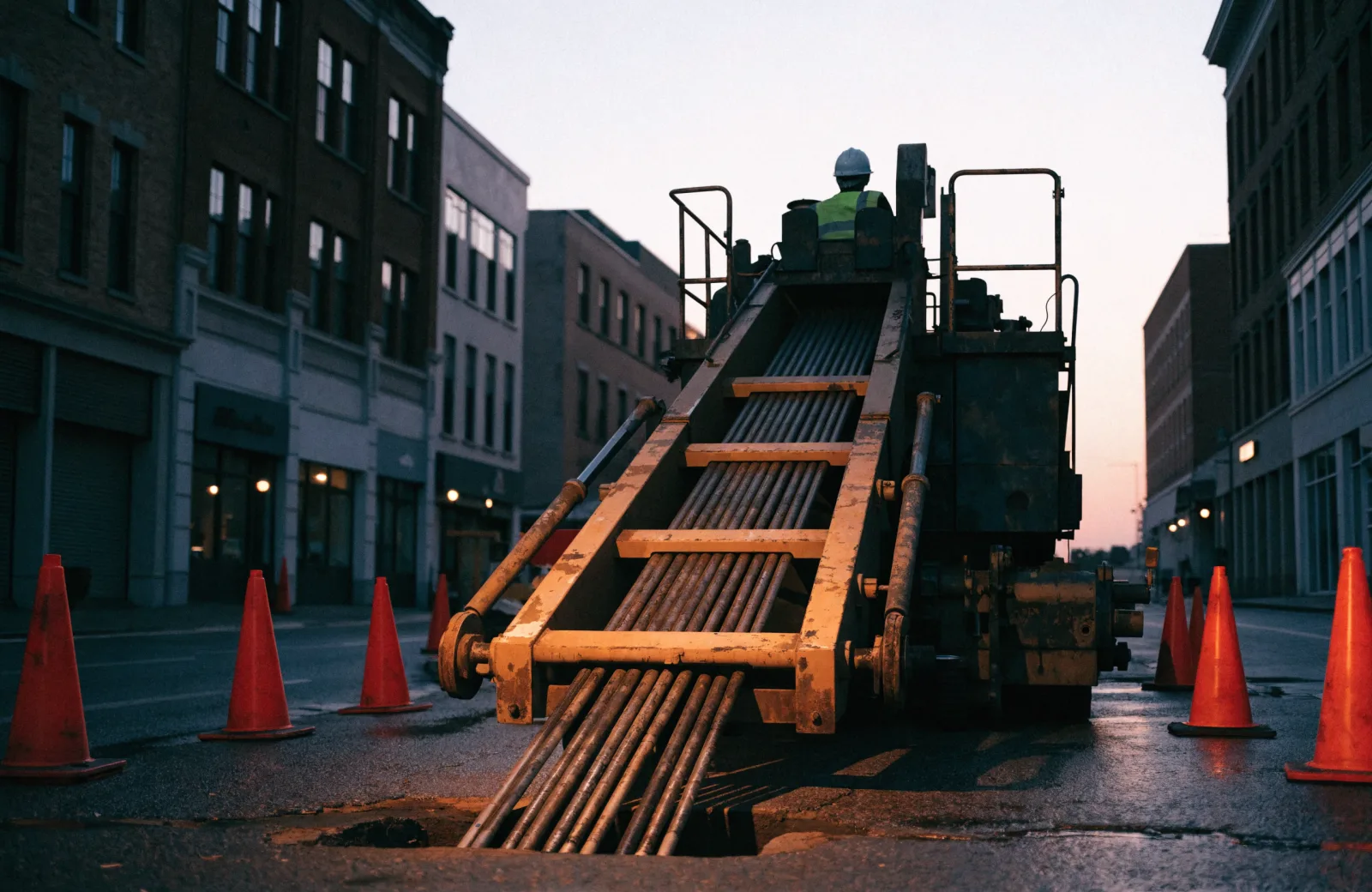
Directional boring, also called horizontal directional drilling or HDD, installs pipe or conduit underground without digging a trench across the route. A steerable drill head enters the ground at a shallow angle, follows a planned path under the road, driveway, landscaping, or creek, and exits at a pit on the far side. The crew then enlarges that pilot hole and pulls the new line back through it. The surface in between never gets opened.
We bore water services, gas lines, electrical conduit, and fiber and communications duct, in sizes from 2 inches up to 12 inches, on runs from a 30 foot driveway shot to several hundred feet under a public street. One honest limit: gravity sewer needs a precise continuous fall, and standard HDD cannot hold grade tightly enough for most gravity applications, so those lines usually stay open cut. Pressurized lines, which do not care about grade, are where boring shines.
For a full picture of the boring rigs, excavation equipment, and crews behind this work, see our capabilities page.
What Moves the Per-Foot Price
Six factors set the price of a bore. When a quote surprises you, one of these is usually the reason.
| Cost factor | What it does to the price |
|---|---|
| Soil conditions | The single biggest driver. Sand and loam drill fast. Cobble deflects the head. Rock can multiply drilling cost by 4x and may require a different rig entirely. |
| Pipe diameter | Bigger pipe means a bigger final hole. Bores over about 4 inches need one or more reaming passes, and each pass is another trip through the bore. |
| Depth and profile | Deeper bores and crossings that must duck existing utilities take longer to steer and verify. |
| Length vs. mobilization | Mobilization is fixed, commonly $2,000 to $10,000 with rig size. Spread over 500 feet it disappears; on a 40 foot bore it dominates the price. |
| Locates and potholing | Every bore path near existing utilities gets potholed (vacuum excavated) to visually confirm depths before the drill head goes anywhere near them. |
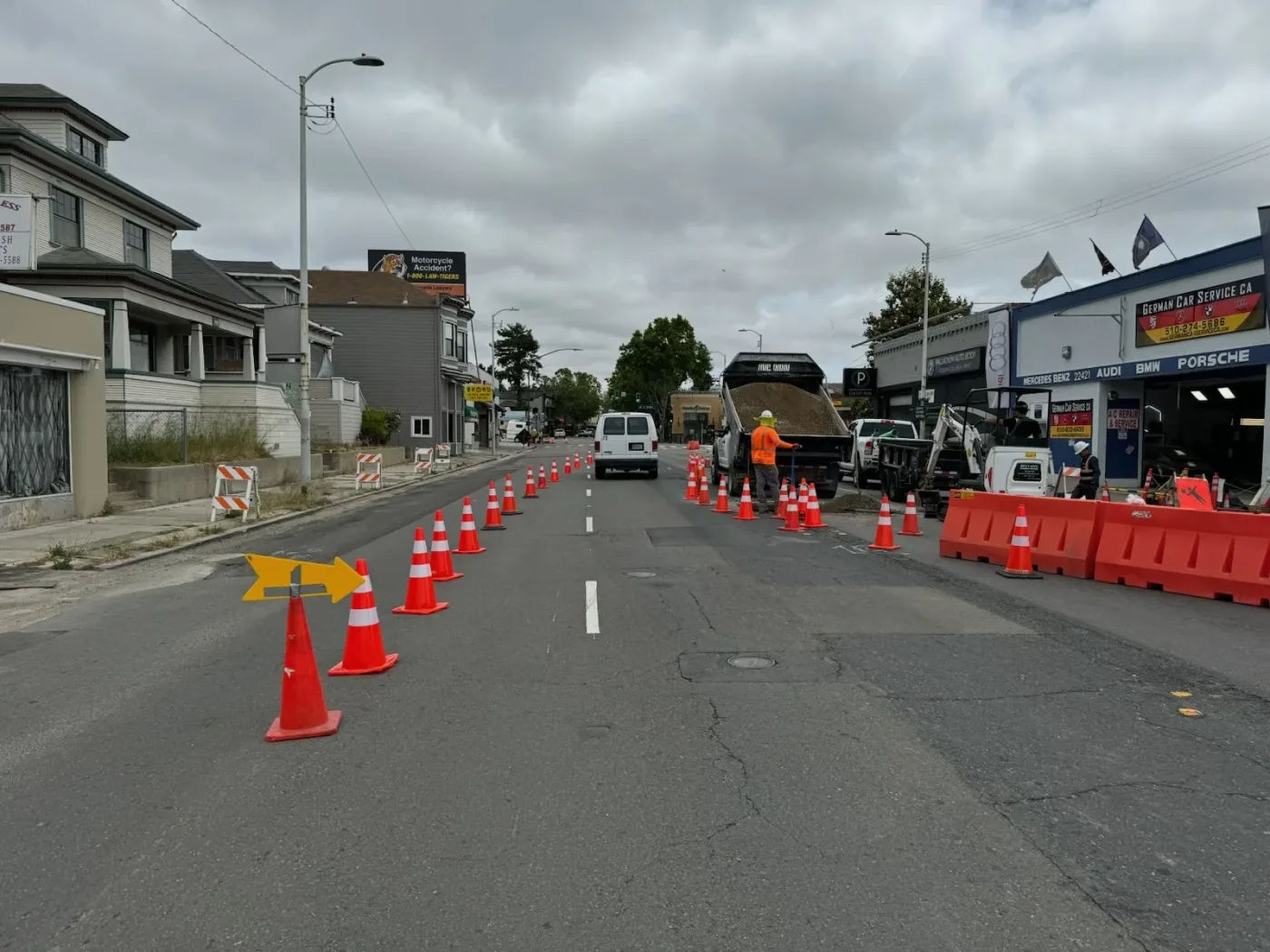
| Site access and traffic control | Street work needs encroachment permits, plates, and sometimes flaggers. Tight urban staging slows the mud system and pipe layout. |
The quiet advantage hiding in these numbers: a bore price includes almost no surface restoration, because there is almost no surface damage. A trench price is not finished until you add concrete, asphalt, or landscape repair. Keep that in mind through the next section.
Boring vs. Open Trench: How We Decide
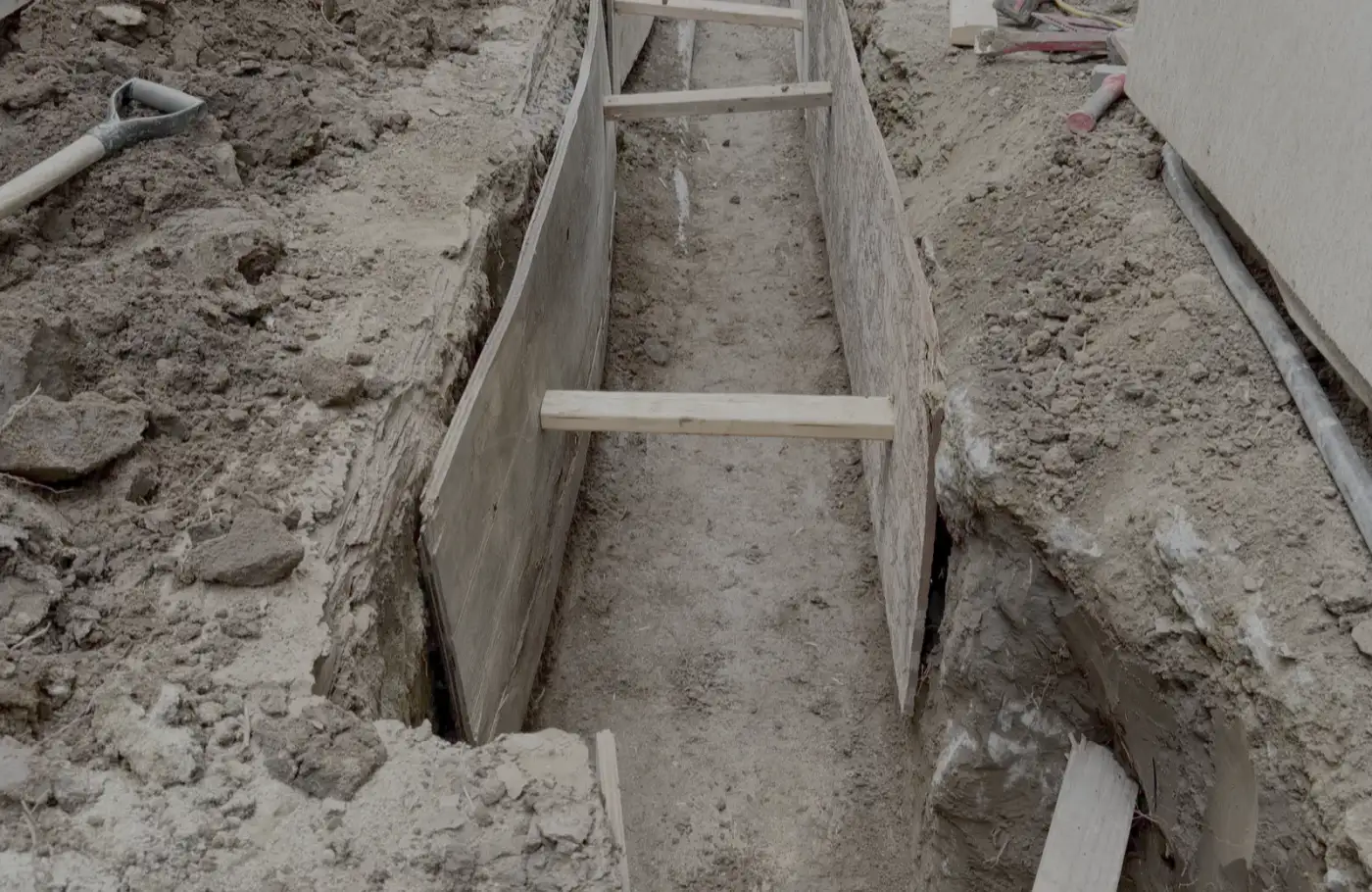
Open trenching is cheaper per foot. In the Bay Area, trenching alone runs $5 to $40 per foot before pipe and restoration, and in open dirt with nothing on the surface it is usually the faster, cheaper, better choice. Boring earns its premium when something valuable sits between point A and point B.
| Condition | Open trench | Directional boring |
|---|---|---|
| Open ground, dirt or lawn you can regrade | Wins on price and speed | Overkill unless runs are long |
| Under a driveway, patio, or retaining wall | Demolition plus flatwork repair | Wins, no demolition at all |
| Crossing a public street | Street cut, traffic control, moratorium fees, permanent patch | Wins in most cases |
| Multiple utilities on the same route | Wins, one joint trench carries several lines | Each line is its own bore |
| Mature trees and finished landscaping | Root damage, tree protection zone conflicts | Wins, bores beneath root zones |
| Solid rock | Slow and loud but predictable | Possible with rock tooling at a steep premium |
The math usually turns on restoration. A 60 foot open cut across a lawn might beat a bore by a couple thousand dollars. The same 60 feet across a stamped concrete driveway flips hard the other way once you price demolition, off-haul, and matching the finish. Street crossings flip even harder: Federal Highway Administration research on pavement utility cuts shows that every cut permanently weakens the surrounding pavement, which is exactly why many Bay Area cities charge street damage restoration fees, enforce paving moratoriums on recently paved streets, and quietly prefer bores in the permit process.
Two more scenarios worth naming. On new construction with open graded dirt, a joint trench that carries power, gas, and communications in one cut is almost always the right call, the approach we walk through in our guide to trenching for underground gas lines. And on long single-utility runs, say 300 feet of electrical conduit to a back building, boring gets more competitive with every foot because the fixed costs stop mattering.
When Boring Is the Only Real Option
Some jobs are not a cost comparison. The city or the site decides for you:
- Recently paved streets. Most Bay Area cities enforce paving moratoriums of 3 to 5 years on new asphalt. During that window, an open cut is either prohibited or priced into the encroachment permit at a level that makes boring the only sane bid.
- State routes and busy arterials. Caltrans and city traffic engineers frequently require trenchless crossings so lanes stay open.
- Creeks and drainage channels. Boring passes beneath the bank without touching the waterway, avoiding a hornet’s nest of environmental permitting.
- Protected trees. Bay Area heritage tree ordinances put trenches inside driplines under arborist review. A bore at depth passes beneath the root zone.
- Structures in the way. When the route runs under a garage corner, a sound wall, or a neighbor’s improvements, there is no trench option to price.
What a Bore Day Looks Like
If we are boring on your property or your project, here is the actual sequence.
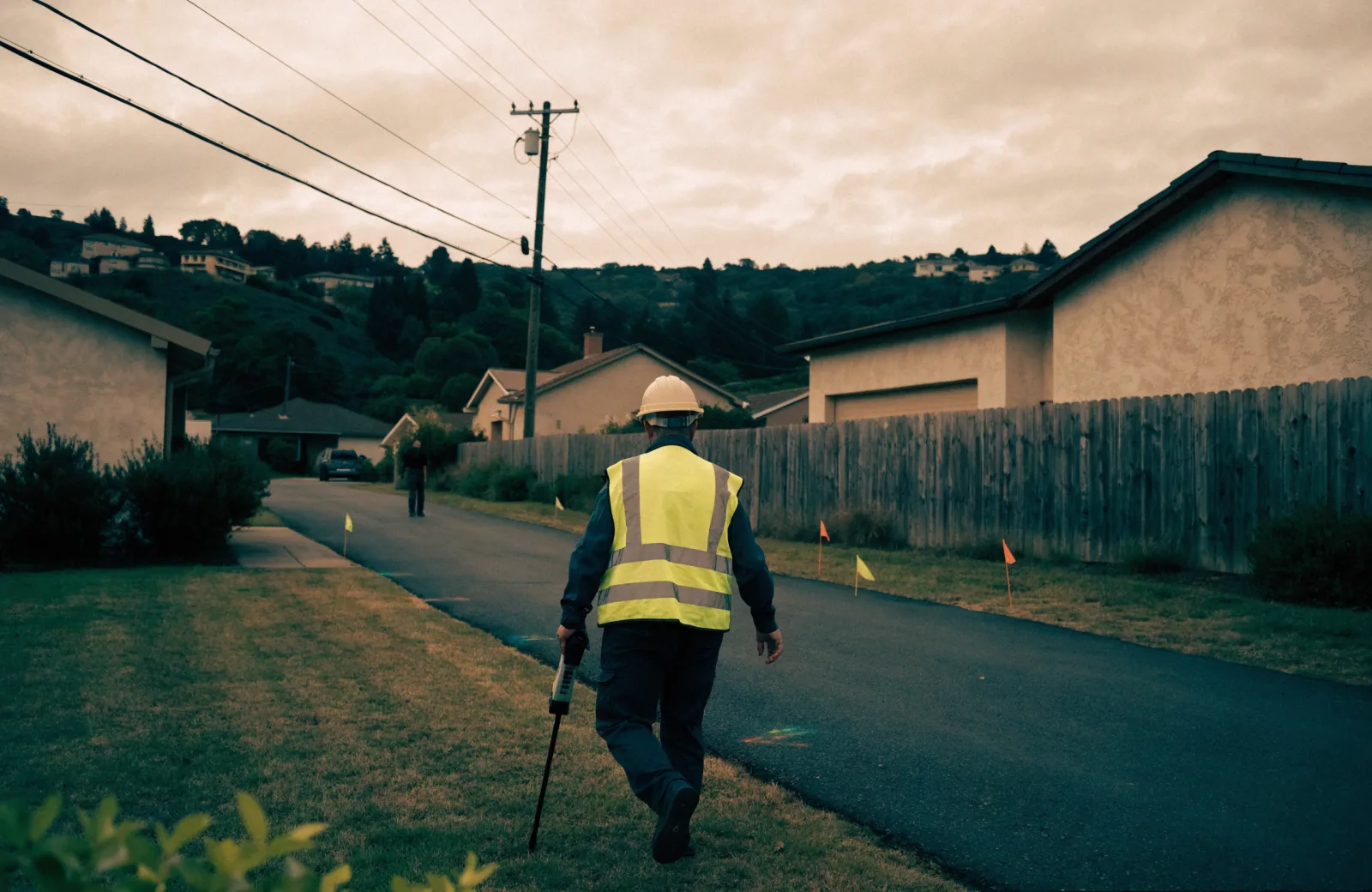
Locates come first, by law. California requires notifying USA North 811 at least two working days before any excavation. Utility owners mark their lines in spray paint and flags. On top of the marks, we pothole with a vacuum excavator at every point the bore path crosses an existing line, so we know true depths, not assumed ones. On congested sites this verification step is its own discipline, one we covered in our post on subsurface utility engineering.
Setup. The crew digs a small entry pit and an exit pit, typically a few feet square, stages the rig, anchors it, and mixes drilling fluid, a bentonite clay slurry that cools the head, carries cuttings out, and holds the hole open. On a residential bore this is a morning.
Pilot bore. The operator advances the steerable head along the planned path while a second crew member walks the surface above with a locating receiver, reading the head’s depth and pitch every rod. The bore gets steered in real time, which is how it ducks under that water main with the required separation instead of hoping. The pilot is done when the head surfaces in the exit pit, on line and on depth.
Reaming. For anything bigger than small conduit, the crew swaps the head for a reamer and pulls it back through, enlarging the hole. Larger pipes take multiple passes with stepped-up reamers until the bore is roughly 1.5 times the pipe diameter.
Pullback. The product pipe, often fused HDPE laid out in one continuous string on rollers, connects to the drill string through a swivel and gets pulled back through the finished bore. When the pulling head reaches the rig, your new line is in the ground, end to end, under everything.
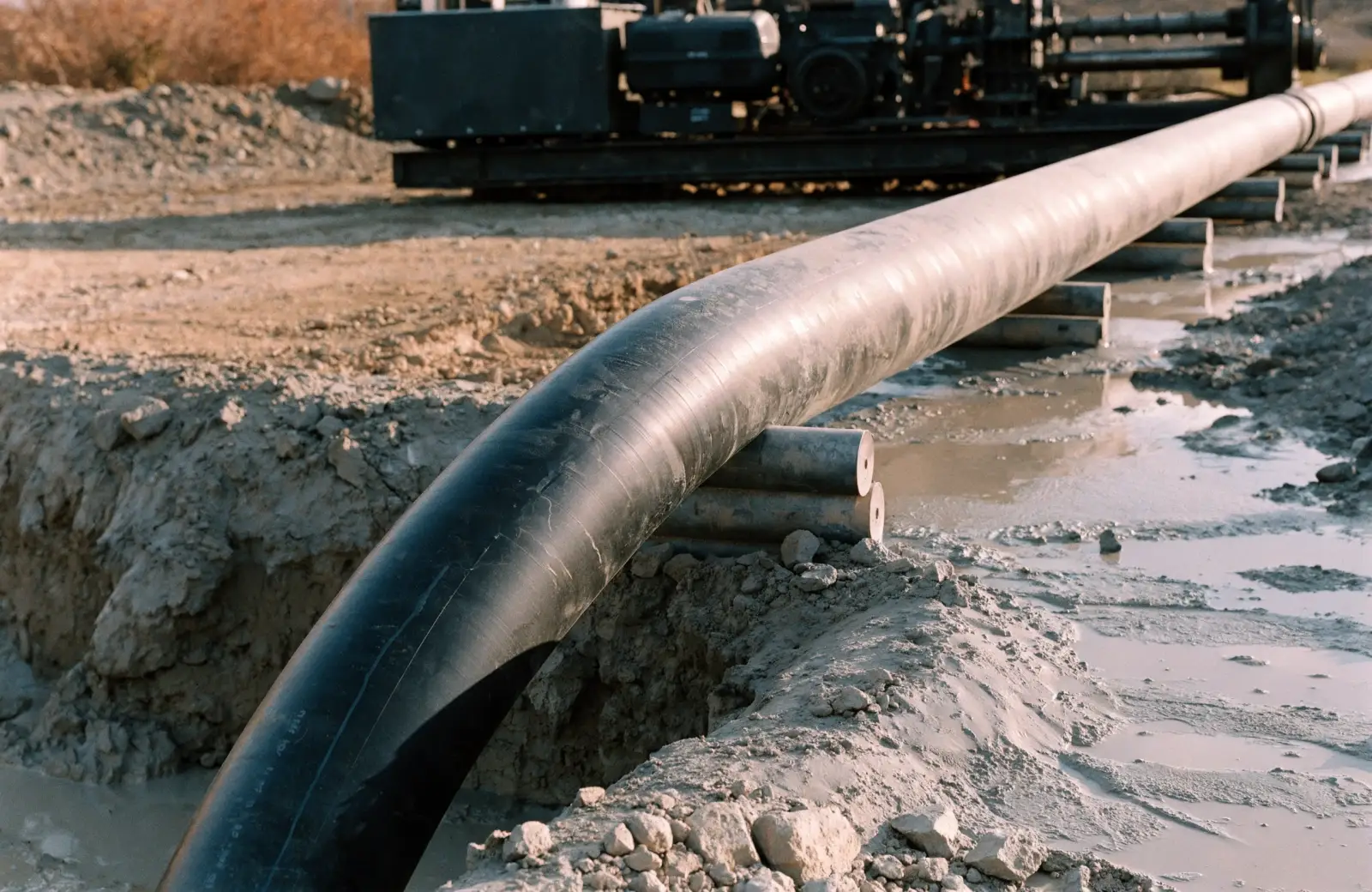
Cleanup. Used drilling fluid is contained and hauled off, pits are backfilled and compacted, and surface disturbance amounts to two small patches. A typical residential crossing is one day. A 300 to 500 foot street bore with reaming passes usually runs two to five days.
Bay Area Factors That Move the Number
Local conditions are why national per-foot averages undershoot real Bay Area quotes:
- Soil that changes by the block. Bay mud near the shoreline drills easily but can deform around the bore. East Bay hills throw cobble, claystone, and chert at the head. Peninsula and South Bay alluvium is the easy middle. Soil is the first thing we check before quoting, and it is why per-foot prices from other regions do not transfer.
- Permits and inspectors. Any bore that touches public right of way needs an encroachment permit, and several cities also want a bore plan showing depth and separation from their mains. We handle this paperwork as part of our underground construction services, but it is real cost and real lead time.
- Congested corridors. Older East Bay and San Francisco streets stack gas, water, sewer, power, and abandoned lines in a narrow band. More crossings mean more potholes and slower steering.
- Labor and disposal. Prevailing wage on public work, union operator rates, and drilling fluid disposal fees all price higher here than the national tables assume, which is consistent with the 20 to 40 percent Bay Area premium across utility work.
How to Read a Boring Quote
Quotes for the same bore can land thousands of dollars apart because they do not include the same things. Before you compare numbers, check five lines:
- Mobilization. Is it a separate line or baked into the per-foot rate? Either is fine; not knowing which is not.
- Locates and potholing. Confirm vacuum potholing of crossings is included. A quote that skips verification is cheap for a dangerous reason.
- The rock clause. Nearly every bore contract prices for expected soil and carries a changed-conditions rate if the head hits rock. Ask what that rate is before work starts, not after.
- Permits and traffic control. On street crossings, someone pays for the encroachment permit, plates, and flaggers. Make sure that someone is identified.
- Fluid disposal and cleanup. Bentonite slurry must be contained and disposed of properly, not washed into a storm drain. It should be a stated part of the scope.
A thorough contractor’s quote answers all five without being asked. That, more than the bottom-line number, tells you who you are dealing with. For how boring line items fit into a full project budget alongside trenching, materials, and restoration, our underground utility installation cost guide breaks down the whole stack.
Frequently Asked Questions
How deep does directional boring go?
Most utility bores run 3 to 6 feet deep, set by code cover requirements for the utility type plus required separation from existing lines. Road and creek crossings often go deeper, 10 feet or more, to clear everything with margin. Depth itself adds little cost; what costs money is the steering and verification around other utilities.
How long does a bore take?
A 40 to 80 foot residential crossing is typically one day, including setup and cleanup. A 300 to 500 foot bore with reaming passes runs two to five days. Compare that with a street cut, where the digging is fast but restoration, inspection, and paving stretch the calendar.
What utilities can be installed with directional boring?
Water services and mains, gas lines, electrical conduit, and fiber or communications duct, in roughly 2 to 12 inch sizes for most rigs. Pressurized and cable systems are ideal because they tolerate the bore’s gentle curves. Gravity sewer usually cannot hold precise grade through a standard bore and stays open cut.
How much does it cost to bore under a driveway?
Most Bay Area driveway crossings for a water, gas, or power line land between $1,500 and $5,000 total, driven more by the contractor’s minimum and mobilization than by footage. That sounds steep for 30 feet of pipe until you price the alternative: cutting, breaking, off-hauling, and repouring a slab, then living with a patch seam forever.
Why is the per-foot price so much higher on my short bore?
Because the fixed costs, mobilization, setup, locating, and mud handling, get divided by very few feet. A $3,000 bill on a 40 foot bore is $75 per foot; the same crew doing 400 feet might bill $12,000, or $30 per foot. Neither number is padded. Short bores simply carry the whole setup cost on a few feet of pipe.
Does boring guarantee no surface damage?
It removes the trench, not every trace of work. Expect two small pits, some equipment traffic, and contained drilling fluid at the entry and exit. There is also a small managed risk called frac-out, where drilling fluid finds a crack to the surface; an experienced crew controls fluid pressure and monitors the path to prevent it. That is a fraction of the disturbance of an open cut, but it is fair to know it is not zero.
Get a Bore Priced by the Crew That Will Drill It
Total Underground Construction bores water, gas, electrical, and communications lines across San Leandro, Oakland, Hayward, Fremont, San Francisco, the Peninsula, and the greater Bay Area. We run our own rigs and crews, handle the locates, potholing, permits, and traffic control in house, and give you one number that includes the whole scope, from the first 811 ticket to the last compacted pit. We also install and replace water lines end to end, so the bore and the connections come from one contractor.
Request a free estimate and tell us what the line needs to cross. We will tell you honestly whether boring or an open trench is the better answer for your site.