Getting PG&E gas and electric service to a new development is mostly a dirt problem. PG&E designs the system and pulls the cable, but the trench, conduit, boxes and pads, and every inspection before backfill are on your side of the schedule. That’s where most energization dates slip.
This guide comes from Total Underground Construction, a Class A General Engineering contractor (CSLB License 1094194) in San Leandro that digs trench and sets conduit for PG&E gas and electric services. Our founder, Joseph Dometita, has completed PG&E’s Applicant Installer Safety, Quality, and Conduct Assessment and holds Operator Qualifications OQ 02-15 and OQ-0507. The rules, dates and dollar figures below come from PG&E’s tariffs, the 2026 Greenbook and PG&E’s published process maps, and each one is linked where it appears.
“Applicant installation” covers two things here. The first is the substructure work every applicant does under PG&E’s Rules 15 and 16. The second is the bigger option of hiring your own qualified contractor to install facilities PG&E would otherwise build. If you’re a developer with a lot under contract and a lender asking for a power date, you need the real sequence. If you’re a GC or estimator pricing site utilities against a bid date, you need to know which trench work is yours and what the inspector checks before backfill. And if you’re the civil engineer or project manager holding the dry utilities together, you need every hold point on one page.
When you finish, you’ll know which install option fits your project, what the 2023 and 2024 fuel rule changes did to your PG&E costs, who PG&E now allows to do the work, and what to ask before you award the trench. The guide follows four questions in order: who builds what, what it costs, who’s allowed to install it, and how the job runs from application to energized meter, including the inspections and the usual delays.
Start with the term itself, because people use it for two different scopes.
What PG&E Applicant Installation Actually Covers
PG&E applicant installation is a tariff option that lets you hire a qualified contractor to install gas and electric facilities that PG&E will own once they pass inspection. It sits on top of work you already owe: under PG&E’s extension rules, the applicant always provides the trench, conduit and substructures, while PG&E normally installs the cable, gas pipe and equipment. Choosing applicant installation moves some of PG&E’s share to your contractor too.
The 2026 PG&E Greenbook (Section 1.12) gives you three installation options:
| Option | Your contractor’s scope | PG&E’s scope | PG&E inspection |
|---|---|---|---|
| PG&E-Installed Work | Nothing past PG&E’s point of attachment; you own from the service connection to the building | All construction, including substructures | Not required |
| PG&E-Applicant Shared Work (substructure only) | Trenching, backfill, compaction, conduit, boxes and pads with grounding, service riser conduit, paving cut and patch | Cable, gas pipe, equipment and connections | Yes, at each hold point |
| Applicant-Performed Work | Everything in shared work, plus electric equipment shown on the drawing, terminations, risers on existing poles, and the gas service | Tie-ins to live facilities, which only PG&E employees may make | Yes, on every installed facility |
PG&E’s applicant install page sums up the bigger option: “A qualified contractor must provide all the necessary material and installation of the gas and/or electric facilities for the project,” and you pay PG&E advances covering its engineering, administration, tie-ins and any added facilities (PG&E Applicant Design & Install). One detail people miss: the Greenbook warns that choosing shared work “may extend the project timeline,” because your dig and PG&E’s crew are now two calendars that have to meet.
What Rules 15 and 16 Put on Your Side of the Line
Under PG&E’s electric Rule 15 (distribution line extensions) and Rule 16 (service extensions), the applicant is responsible for excavation, conduit, substructures and protective structures, built to PG&E’s design. PG&E furnishes and installs the cables, switches, transformers and other distribution facilities. Whatever you build outside your own premises gets handed over to PG&E once PG&E accepts it.
Rule 16 is the one that lands on most commercial and multifamily sites, and it spells out what the applicant owes for the service lateral:
- A clear route across private property, free of anything that would block construction.
- All trenching, backfilling and other digging, including permit fees.
- Conduit (with pull wires) and substructures on your premises, which you own and maintain, plus any needed in PG&E’s franchise area, which PG&E takes over after acceptance.
- Protective structures PG&E specifies for its equipment on your property.
Gas splits the work differently. Under Gas Rule 15, trenching for a gas main is part of PG&E’s job, but you can choose to provide the trench yourself, and then you pull the permits. Under Gas Rule 16, the service trench is yours: the excavation, the permit fees, and any meter or regulator vaults and pads. Our guide to trenching for underground gas lines covers what that trench looks like in the field.
In practice, gas and electric usually share one excavation. The Greenbook notes that PG&E’s gas service “is usually installed in a common joint trench with the electric service,” typically along with phone and cable. Water, storm, sewer and irrigation lines are not allowed in that trench, so on a full site package they go in separate runs, which the same crew can build as part of our underground construction services. A joint trench needs a Joint Trench Composite Drawing and a Form B job estimate authorization, and PG&E has to approve the trench design before anyone digs. Our joint trench guide covers how to sequence and price one. Two more Greenbook details that catch developers late: if gas runs in your trench, PG&E requires an easement at least 10 feet wide for both mains and services, and any other facility you want in the joint trench needs a written exception request approved before work starts.
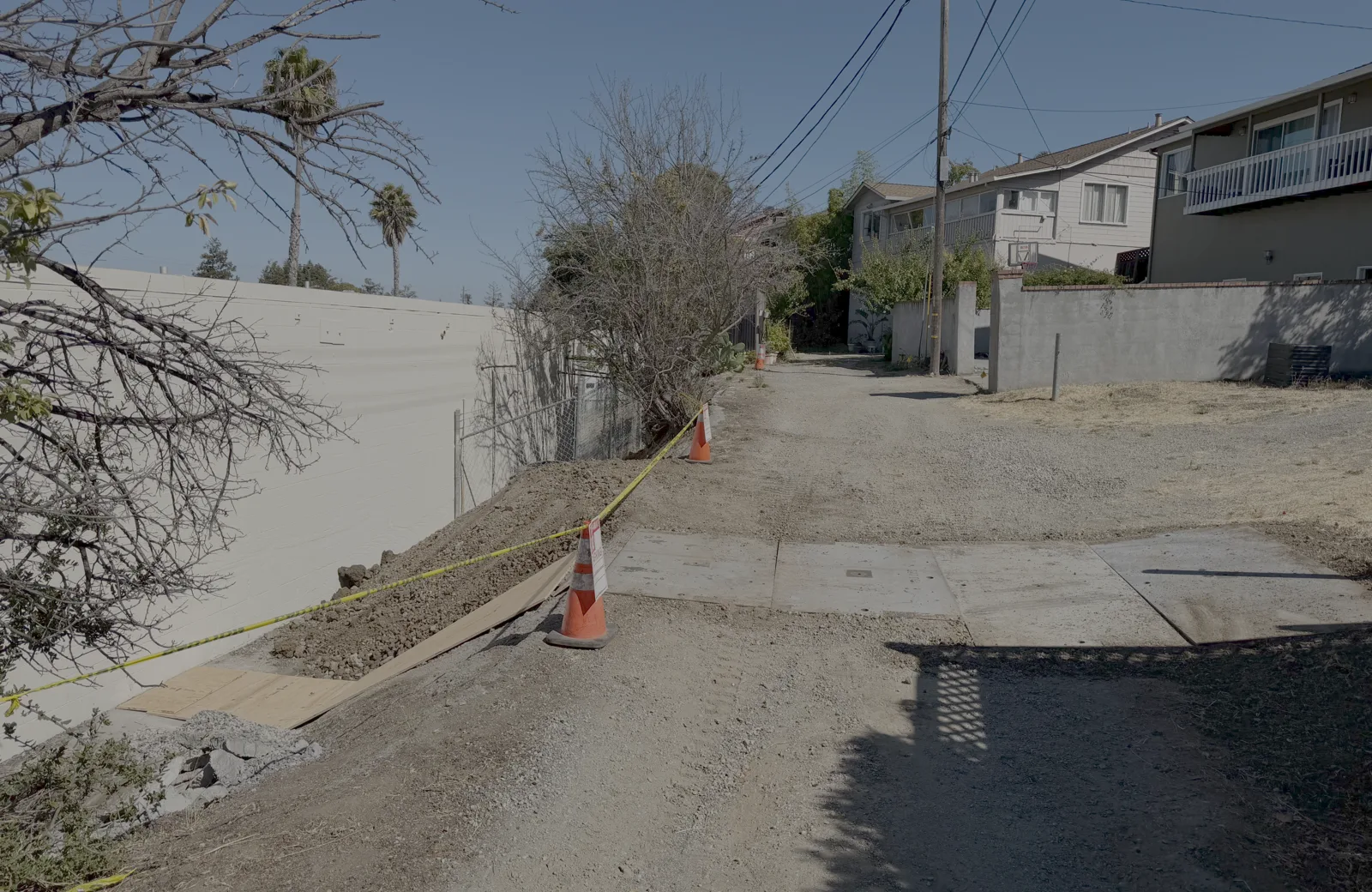 A plated gas trench crossing an alley easement in Belmont, running about 40 feet to the main. Gas in the trench brings PG&E’s 10 foot easement minimum with it.
Handing a facility over doesn’t end your obligation. PG&E’s facility inspections process map lists a one year equipment warranty and a two year trench guarantee from final acceptance, or longer if your permit requires it. Your trench sub’s backfill and compaction are part of your risk for two years after PG&E signs off.
Shared Work or Full Applicant Install: How to Choose
Choose based on what controls your critical path. If waiting for PG&E crews will idle your trades, applicant-performed work puts more of the schedule in your hands. If you only want control of the dig, shared work keeps the scope simple. And if you’d rather not coordinate inspectors at all, PG&E-installed work is the trade, at PG&E’s full estimated cost and on PG&E’s crew calendar.
By project type, it usually breaks down like this:
- If you’re building one commercial building or a small infill project with a single service, shared work (substructure only) is usually the right call. Your trench sub digs, sets conduit and boxes and pours pads, and PG&E handles cable and gas pipe. You have fewer inspection types to manage and less PG&E equipment in your contractor’s hands.
- If you’re building a multi-lot subdivision or a phased project, price applicant-performed work. Your contractor’s price for the work PG&E would normally do goes to PG&E on its form, and under Rule 15, Section G the lower of that number and PG&E’s own estimate is what counts toward refunds and allowances. You still pay PG&E for its design, administration and a fixed inspection fee.
- If you’re a smaller owner with no one to manage inspections, PG&E-installed work removes PG&E inspections entirely. You pay PG&E’s total estimated installed cost for the substructure work, and your start date depends on when PG&E’s crew is free.
Picture a developer building six townhomes on an infill lot in Hayward, with framing set for March and a lender asking for a power date. Under shared work, the trench sub digs and sets conduit and boxes, PG&E pulls cable when its crew is scheduled, and the developer manages two calendars. Under applicant-performed work, a prequalified installer also sets the gas service and the electric equipment shown on the drawing, so PG&E’s visit shrinks to the tie-in. The second path asks more of the contractor and the inspection calendar. What it buys is fewer days waiting for a PG&E crew slot you don’t control.
What It Costs: Allowances, Advances and the Fuel Rule Changes
Your PG&E bill for a new development is PG&E’s estimated installed cost minus any allowance your load earns. Since 2023, whether your buildings burn gas largely decides whether you get an allowance at all. Gas line extension applications submitted on or after July 1, 2023 no longer qualify for allowances except for a narrow set of CPUC-approved Eligible Projects. Electric allowances went away for mixed-fuel new construction on July 1, 2024.
Under Electric Rules 15 and 16 and Gas Rule 15, the two paths compare like this:
| All-electric new construction | Mixed-fuel new construction (gas plus electric) | |
|---|---|---|
| Electric line extension allowance | $3,255 per residential meter or dwelling unit; a revenue formula for non-residential load | Removed July 1, 2024 |
| 50 percent non-refundable discount option | Available | Removed |
| 10-year refundable advance option | Available | Removed |
| How the electric extension is billed | PG&E’s estimated cost | Final actual cost at project completion (from January 1, 2025) |
| Gas line extension allowance | Not applicable | None for applications on or after July 1, 2023, except CPUC-approved Eligible Projects |
A few more money rules that belong in your pro forma:
- Rule 15 treats PG&E’s estimated value of the excavation, conduit and protective structures you provide as a non-refundable contribution: you pay for that work, and none of it comes back as a refund.
- The trench itself is your cost on top of PG&E’s bill. Our underground utility installation cost guide breaks down what drives that per-foot price.
- Advances and contributions are taxable. They carry an Income Tax Component of Contribution (ITCC) at PG&E’s published rate.
- Gas mains are paid up front. For gas main extension applications on or after July 1, 2023, PG&E collects its total estimated cost when you sign the contract, then trues up to actual cost with a final invoice or refund.
- The Greenbook says contracts must be executed within 90 days of receipt, stay valid for 12 months once executed, and the design holds for 18 months from the date the contract is sent.
Say you’re pricing 24 all-electric townhomes. At $3,255 per unit, Rule 15 gives you up to $78,120 in allowance, applied first to the residential service facilities and then to the line extension. Now suppose the design adds a gas range to every unit. The project is mixed-fuel: the electric allowance drops to zero, the discount and refund options go away, and the electric extension is billed at final actual cost. The gas main comes with no allowance either. On a 24-unit job, one appliance decision moves the PG&E line by tens of thousands of dollars, so settle fuel before PG&E prices the job.
Who Can Do the Work: PG&E’s 2025 Installer Prequalification
Since 2025, anyone installing PG&E facilities under a new business application must be prequalified by PG&E. The rule took effect March 1, 2025 for gas applicant installers and April 1, 2025 for electric applicant installers and their civil work. It applies person by person: each individual doing in-scope work completes PG&E’s Safety, Quality, and Conduct Assessment (SQCA) through Industrial Training Services (ITS) and gets an ITS wallet card that PG&E inspectors scan (PG&E Applicant Installer Pre-Qualification Requirements).
PG&E’s scope table draws the line here:
| In scope (prequalified installer required) | Out of scope |
|---|---|
| Gas main, services and appurtenances up to the meter, including excavation, backfill and meter protection | Anything after the meter |
| Concrete gas meter pads and transformer pads | Panel boards and grounding facilities |
| Underground electric conduit, substructures, vaults and boxes up to the meter panel, including excavation and backfill | Paving, landscaping and other restoration |
| Conduit and risers for meter pedestals and switchboards | Temporary service facilities |
| Streetlight conduit, risers and substructures up to the point of service | Customer-owned service poles |
Gas has a second layer. Installers performing operator-qualified tasks on live gas facilities (OQ 0501, 0502, 0504, 0507 and 0215) also need a DOT drug and alcohol testing program registered with the National Compliance Monitoring System. PG&E inspectors scan the card before accepting work at every inspection, and PG&E can revoke a prequalification for things like arguing with an inspector over a failed inspection, booking inspection slots with no work ready, over-pressurizing an air test, or hiding damage to PG&E facilities. The tariffs add their own floor in Rule 15, Section G: the contractor must hold a California license for the type of work and employ properly qualified workers, and PG&E advises checking insurance and the ability to furnish a surety bond.
Picture a GC who awards site utilities to the low bidder in May. At the pre-construction meeting, the inspector scans the foreman’s ITS card and no prequalification comes up. PG&E’s guidance is blunt about what happens next: ITS is the system of record, the qualification has to show when scanned, and if an installer doesn’t get prequalified, another prequalified installer has to be brought onto the job. The trench sits open while the GC finds one. A card check before award would have caught it.
For our part, Joseph Dometita completed the PG&E Applicant Installer SQCA on 03/04/2026 and holds OQ 02-15 (Installation of Pipe, Backfill, Compacting, expires 06/30/2027) and OQ-0507 (Damage Prevention During Excavation, expires 12/31/2028). We list them with our other bid credentials on our capabilities and qualifications page so your prequalification file has them before you ask. Check every installer’s card the same way, ours included.
From Application to Energized Meter, Step by Step
A PG&E new service job runs in a fixed order: application, design, contract, dependencies like easements and permits, a pre-construction meeting, trenching and inspections, PG&E’s crew work, then energization once your city releases the meter. PG&E’s applicant design process map puts the average for PG&E’s own share at 182 calendar days after the application and says at least 5 percent of projects can take up to 357 days. Your trench, permits and paperwork come on top of that.
The sequence, with the hold points a trench contractor cares about:
- Apply in Your Projects. Submit through PG&E’s Your Projects portal with site plans, line drawings and load sheets. PG&E’s application resources page says a representative will contact you within five business days.
- Design. PG&E designs the job, or a qualified applicant designer does. Rule 15 requires applicant designs to be done or directed by a licensed professional engineer, and PG&E does one plan check free. Joint trench jobs need the composite drawing and Form B here.
- Contract and dependencies. Sign and pay within 90 days. Clear easements (10 feet minimum where gas is involved), land rights and permits. PG&E’s map notes that agency permit time isn’t counted in its 30 days.
- Pre-construction meeting. Hold it at least 10 business days before work starts. The applicant, the applicant’s contractor, the PG&E job owner, PG&E’s gas and electric inspectors, and representatives of every other joint trench utility attend. This is where the inspector should scan your installers’ ITS cards.
- Dig, inspect, document. Every inspection needs an active Underground Service Alert (811) ticket. Email PG&E form TD-4462M-F02, “Request for Inspection,” to your local inspection desk 48 hours ahead; the desk confirms within two business days. Submit as-builts as your job owner directs.
- PG&E construction and energization. Once the inspector clears the job, the PG&E job owner schedules a crew after you submit the approved paperwork and meter release from your city.
Inspection Hold Points Your Schedule Has to Respect
PG&E inspects every applicant-installed facility it will maintain, and the hold points are set in advance. For gas, PG&E inspects after the trench is dug, after the gas stub, at fusion, after pipe lay-in, and on standby whenever you dig around PG&E facilities. For underground electric, it inspects after the trench is dug and conduit is laid, before concrete is poured, at the camera and mandrel tests, cable pulls and equipment installs, and at a final walk-through.
| Work | PG&E’s common inspections (Greenbook Table 1-5) |
|---|---|
| Gas | After trench is dug; after gas stub completion; gas fusion; after gas pipe lay-in; standby during excavation around PG&E facilities |
| Underground electric | Standby during excavation around PG&E facilities; after trench is dug and conduit is laid; cable pull or splices; before pouring concrete for foundations; camera inspection; equipment installs such as a pad mount transformer; mandrel test; final walk-through |
| Overhead electric | Standby during excavation; after pole and meter panel are installed; final walk-through; temporary power |
Two Greenbook rules turn this table into schedule risk. First, for cable pulls and splices, you can book a PG&E inspector for no more than three consecutive days without an inspection supervisor’s approval. Second, the “at-risk” rule: underground conduit, enclosures and substructures can’t go in the ground or into foundations until PG&E issues an approved design. Work installed early is at your risk, no variance requests are allowed, and you pay for any rework.
Say a GC pours a transformer pad in week three to keep the concrete crew busy, two weeks before PG&E approves the design. The approved design moves the pad four feet. That pad comes out at the GC’s expense, and there’s no variance process to argue it. Treat every row in that table as a scheduled date in the job plan, not something you call in when the crew happens to finish.
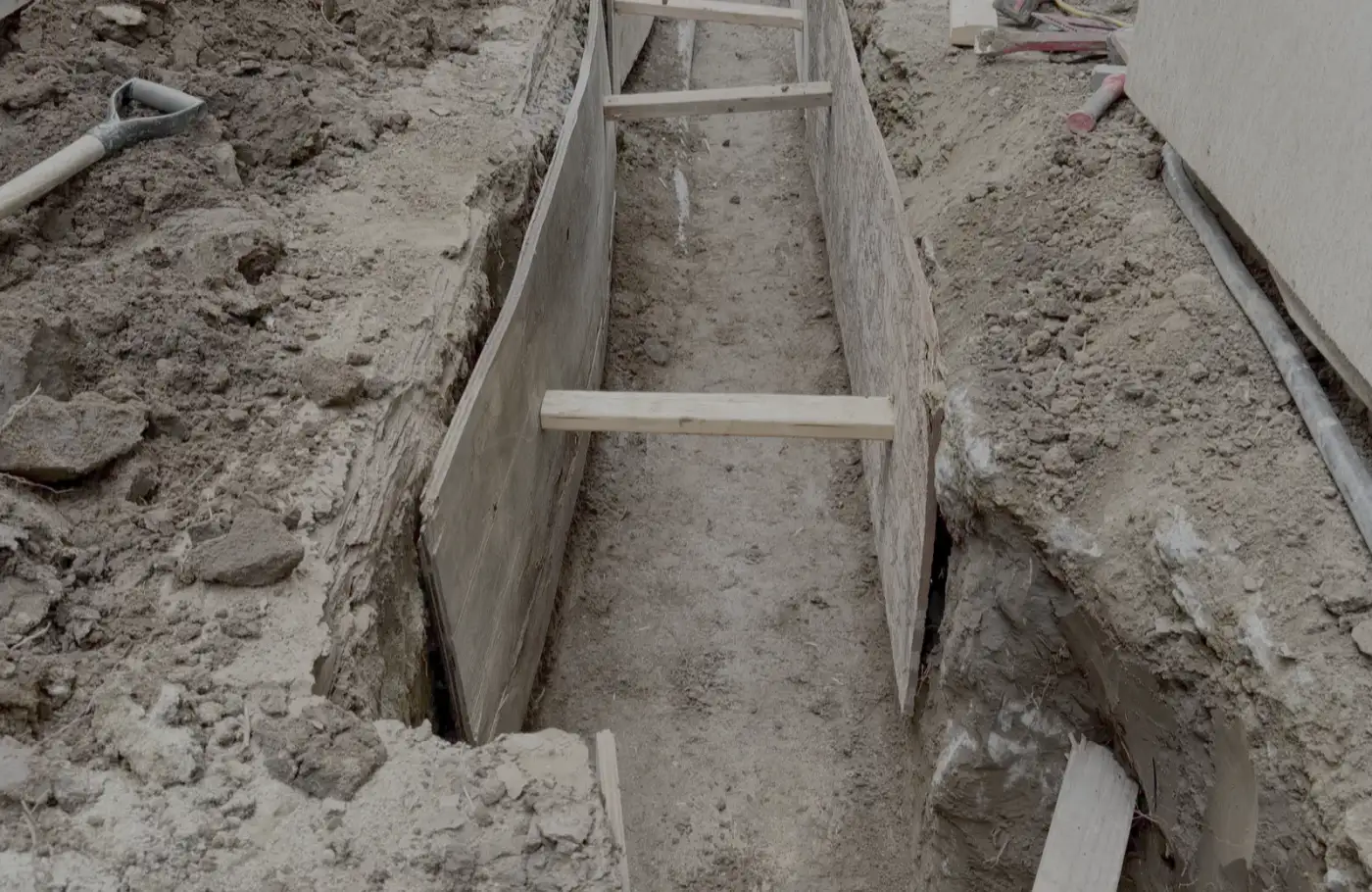
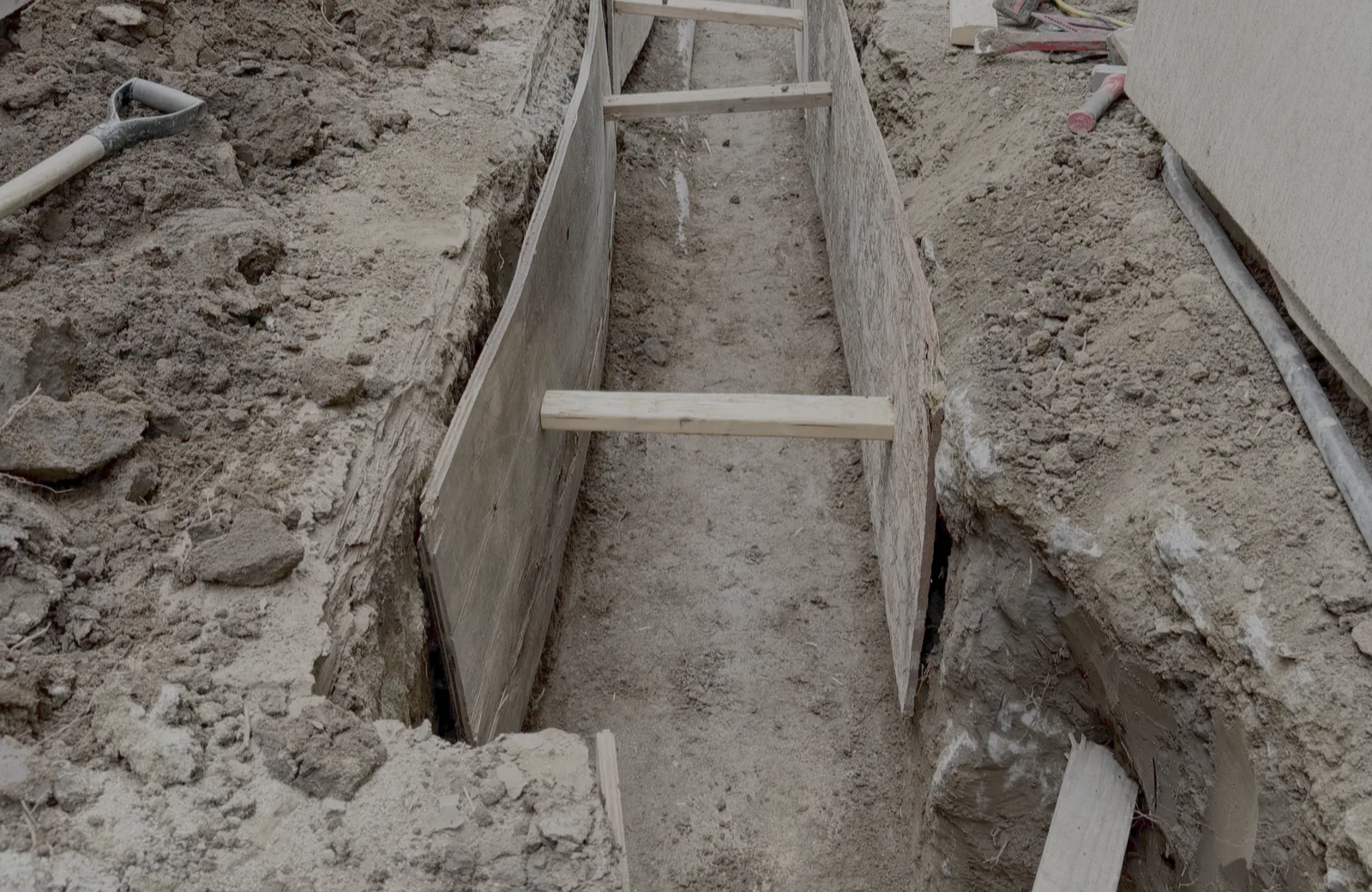
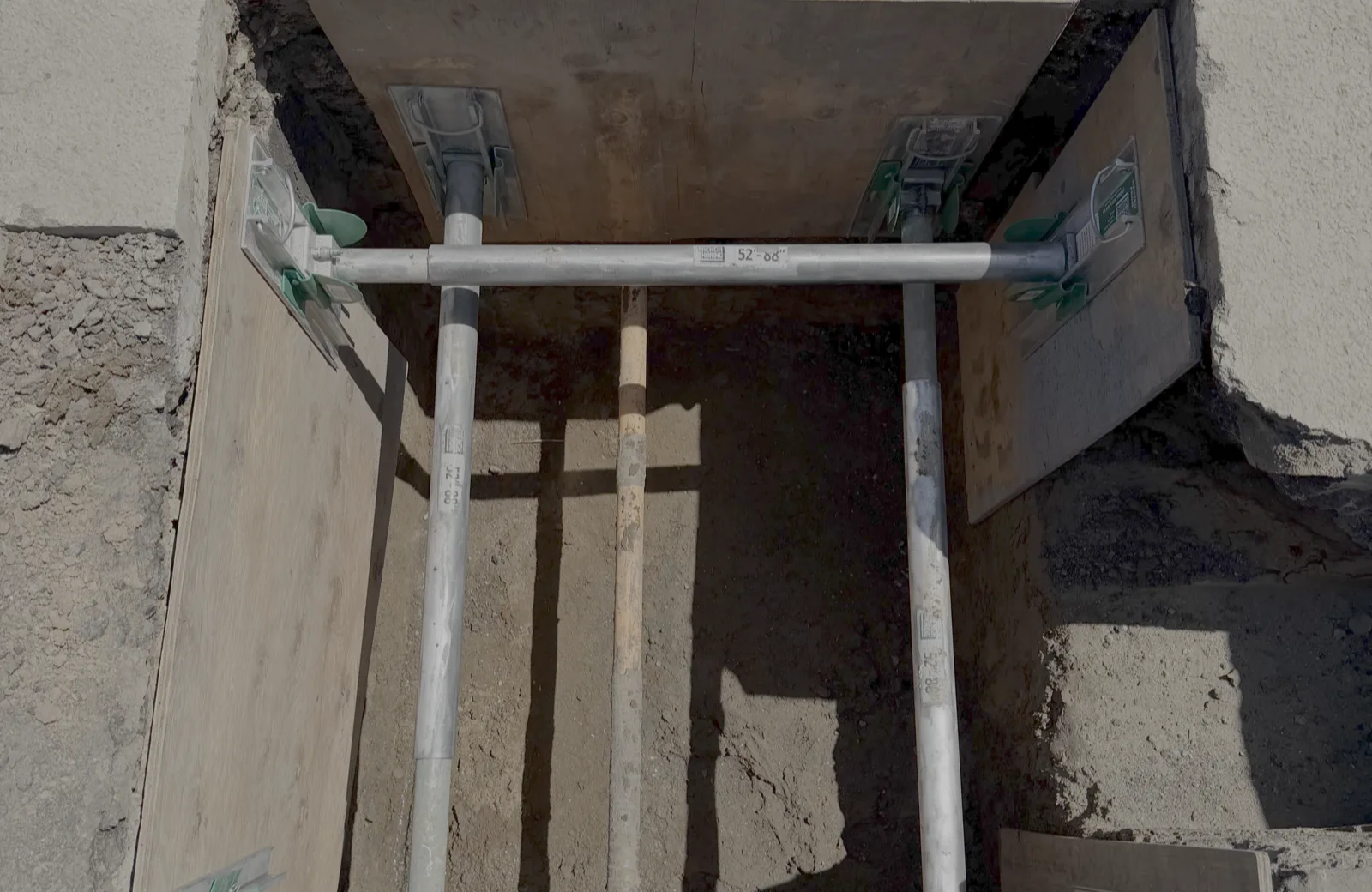 Shoring set to OSHA and PG&E requirements on a gas mainline upgrade. An inspector has to be able to get in safely, so the trench has to be ready before they arrive.
Where PG&E Schedules Actually Slip
Most slipped energization dates trace back to the applicant’s side of the job, and that matters because the CPUC timeline clock doesn’t run on your side. PG&E’s own summary of the CPUC energization targets says the timelines apply only while the utility is in charge, and exclude customer contract payments and site preparation, including building permits. Every day you lose is a day PG&E isn’t measured on.
The usual causes, in the order they show up:
- The contract sits unsigned. Estimates expire after 90 days, and a re-estimate restarts part of the process.
- Scope changes after design. The Greenbook says approved revisions take about 30 days, and PG&E warns that changes after design can affect both schedule and cost.
- Easements and permits. PG&E’s application page warns that environmental permits for utility supply lines can take “from weeks to years.”
- Work installed before the approved design. That’s the at-risk rule above, and the rework is yours to pay for.
- Inspections that don’t happen. No active 811 ticket, a late arrival (which can cancel the appointment), an installer whose card doesn’t scan, or a failed mandrel test each push you to the next open slot.
- Phases that age out. If a phase won’t be built within 18 months of approval, PG&E reviews the design and applies current standards to the remaining phases.
- Late meter release. PG&E schedules its crew only after it has approved paperwork from your city.
Imagine a 40-lot tract built in two phases, with the second phase pushed 20 months by sales. When phase two starts, PG&E reviews the design under the standards in effect then, and the 2026 Greenbook has replaced the 2022/2023 edition. Your phase two drawings may change before anyone digs. Build that review into the phase two start date instead of finding out at the pre-con.
If PG&E’s own share does run past its maximum targets, the process map points you to PG&E’s Delayed Energization Report.
What to Ask a Trench Contractor Before You Award PG&E Work
Before you award PG&E trench work, confirm that every person doing in-scope work is prequalified, then check license, insurance and joint trench experience. Price differences between subs often trace back to whether a bid includes the inspection coordination and documentation PG&E requires. It’s the same check we expect from the general contractors and developers we work with, and four questions cover it:
- “Show me the ITS wallet card for each person on the crew.” You want the SQCA on each card, OQ numbers for any gas covered tasks, and NCMS drug and alcohol status if they’ll work on live gas.
- “What license class and insurance do you carry, and can you bond this job?” Rule 15 requires a California license for the type of work and tells applicants to weigh insurance and the ability to furnish a surety bond.
- “Who prepares the joint trench composite and the gas as-builts?” PG&E requires individuals who prepare gas as-built redlines to complete its Gas As-Built training.
- “How do you schedule inspections?” A good answer names the RFI form, the 48-hour lead, the local inspection desk and who holds the 811 ticket.
PG&E Applicant Installation FAQ
What is the difference between PG&E Rule 15 and Rule 16?
Rule 15 covers distribution line extensions, the lines PG&E extends along streets and into a development. Rule 16 covers service extensions, the run from those lines to your building’s service delivery point. Under both, the applicant provides the trench, conduit, substructures and protective structures to PG&E’s design, and PG&E installs the cable and equipment.
Can my electrician or plumber install PG&E facilities?
Only if each person doing the work holds PG&E’s applicant installer prequalification for that scope, plus the required Operator Qualifications for gas tasks. PG&E’s prequalification covers facilities up to the meter or meter panel. Work after the meter, like the customer’s panel and house piping, falls outside it.
How long does PG&E new service take for a development?
PG&E’s applicant design process map puts the average for PG&E’s own share at 182 calendar days after the application, with at least 5 percent of projects taking up to 357 days. Your trench work, permits, easements and contract payment add to that, and they don’t count toward PG&E’s targets.
Does going all-electric change what I pay PG&E?
Yes. All-electric projects can still earn electric line extension allowances, including $3,255 per residential meter or dwelling unit. Mixed-fuel new construction lost electric allowances on July 1, 2024, and gas line extension applications made on or after July 1, 2023 get no allowance except for CPUC-approved Eligible Projects.
Which Greenbook applies to my project?
PG&E posted the 2026 Greenbook on April 24, 2026. If your contract was sent before that date, PG&E says you may keep using the 2022/2023 Greenbook requirements for up to 18 months from the date the contract was sent.
Plan Your PG&E Trench Scope With Total UC
On most PG&E jobs, energization depends on whether the trench, conduit and substructures pass inspection the first time. Total UC handles that dirt work for PG&E gas and electric services, including joint trench, and we publish our OQ numbers and Joe’s PG&E Applicant Installer assessment date up front. If you have a PG&E job number and a bid date, send us the drawings and look over our PG&E trenching and conduit installation scope, or call (415) 350-3363 to set up a site walk.