PVC (polyvinyl chloride) pipe is the most widely used material in residential and commercial plumbing systems across North America. According to the Plastics Pipe Institute, PVC accounts for over 65% of new water and sewer pipe installations due to its durability, corrosion resistance, and cost-effectiveness. However, PVC is not indestructible. Cracks, splits, and joint failures occur from physical damage, ground movement, improper installation, and age-related brittleness.
If you are dealing with a cracked PVC pipe, whether underground in your San Leandro yard or under a sink inside your home, this guide from Total Underground Construction covers every repair method, the true costs involved, when to repair versus replace, and the Bay Area-specific factors that affect your PVC plumbing system.
Timing matters with PVC pipe issues. Each Bay Area rain season puts significant stress on underground pipes through months of soil expansion, and as the ground dries and contracts afterward, cracks that formed over winter can widen. Whether you are a homeowner who just discovered a problem, a property manager planning seasonal maintenance, or a homebuyer whose inspector flagged a PVC issue, acting early, while ground conditions suit repair work, gives you the best outcome and keeps a small crack from turning into a failure.
Types of PVC Pipe Damage
Not all PVC pipe damage is the same. The type, location, and severity of the damage determines which repair method is appropriate and whether the pipe can be saved or needs full replacement.
Hairline Cracks
Small surface cracks that may weep moisture under pressure but do not cause significant water loss. These are often caused by stress during installation, minor impacts, or early-stage UV degradation on exposed sections. Hairline cracks in pressurized lines will worsen over time as water pressure forces the crack open.
Longitudinal Splits
Cracks that run along the length of the pipe, often caused by manufacturing defects (knit lines from incomplete fusion during extrusion), excessive internal pressure, or ground movement. Longitudinal splits can extend the full length of a pipe section and typically require section replacement rather than patching.
Circumferential Cracks
Cracks that run around the pipe’s circumference, usually caused by external forces such as soil settlement, heavy loads above the pipe (vehicles, construction equipment), or seismic activity. These are common in Bay Area underground installations due to expansive clay soil movement.
Bell or Joint Failures
The bell (socket) end of a PVC pipe is the most structurally vulnerable point. Over-insertion during installation, ground movement, or root intrusion can crack the bell, causing leaks at joints. Joint failures account for a large percentage of PVC sewer line problems in residential systems.
Crush Damage
Severe external force (backhoe strike, heavy vehicle traffic over shallow pipe, improper backfill) can partially or completely collapse a PVC pipe section. Crush damage almost always requires section replacement or full pipe replacement depending on the extent.
UV Degradation
PVC exposed to direct sunlight (above-ground runs, exposed pipe stubs) becomes brittle over time as ultraviolet radiation breaks down the polymer structure. UV-degraded PVC appears chalky or discolored and cracks easily under normal stress.
What Causes PVC Pipes to Crack?
Understanding the root cause helps you choose the right repair and prevent recurrence.
Ground Movement and Soil Conditions
The expansive clay soils found throughout San Leandro, Hayward, Fremont, and much of the East Bay are a leading cause of PVC pipe damage. These soils swell significantly when saturated during winter rains and shrink during summer dry periods. This cyclical expansion and contraction creates shifting forces that stress pipe joints and can crack pipe walls, particularly at connection points and changes in direction.
Spring is a critical transition period. After absorbing winter rain, the ground dries out. This contraction phase is when existing hairline cracks widen and stressed joints begin to separate. If you have noticed slow drains or damp spots since winter, the underlying damage may be getting worse as the soil pulls away from your pipes.
Physical Impact
Excavation near existing pipes, heavy equipment driving over shallow pipe runs, and even aggressive landscaping (digging fence posts, planting trees) can physically damage PVC pipes. Construction-related pipe strikes are one of the most common causes of sudden PVC failures.
Improper Installation
Installation errors create weak points that fail over time. Common mistakes include:
- Excessive solvent cement: Too much PVC cement causes chemical softening of the pipe wall, creating a weak zone adjacent to the joint.
- Insufficient solvent cement: Incomplete fusion leaves voids in joints that allow water infiltration and eventual failure.
- Improper bedding: PVC pipe buried without proper granular bedding material (placed directly on rocky or uneven soil) develops stress points that crack under load.
- Incorrect slope: Sewer lines installed without proper grade create standing water that accelerates wear and allows sediment accumulation.
Tree Root Intrusion
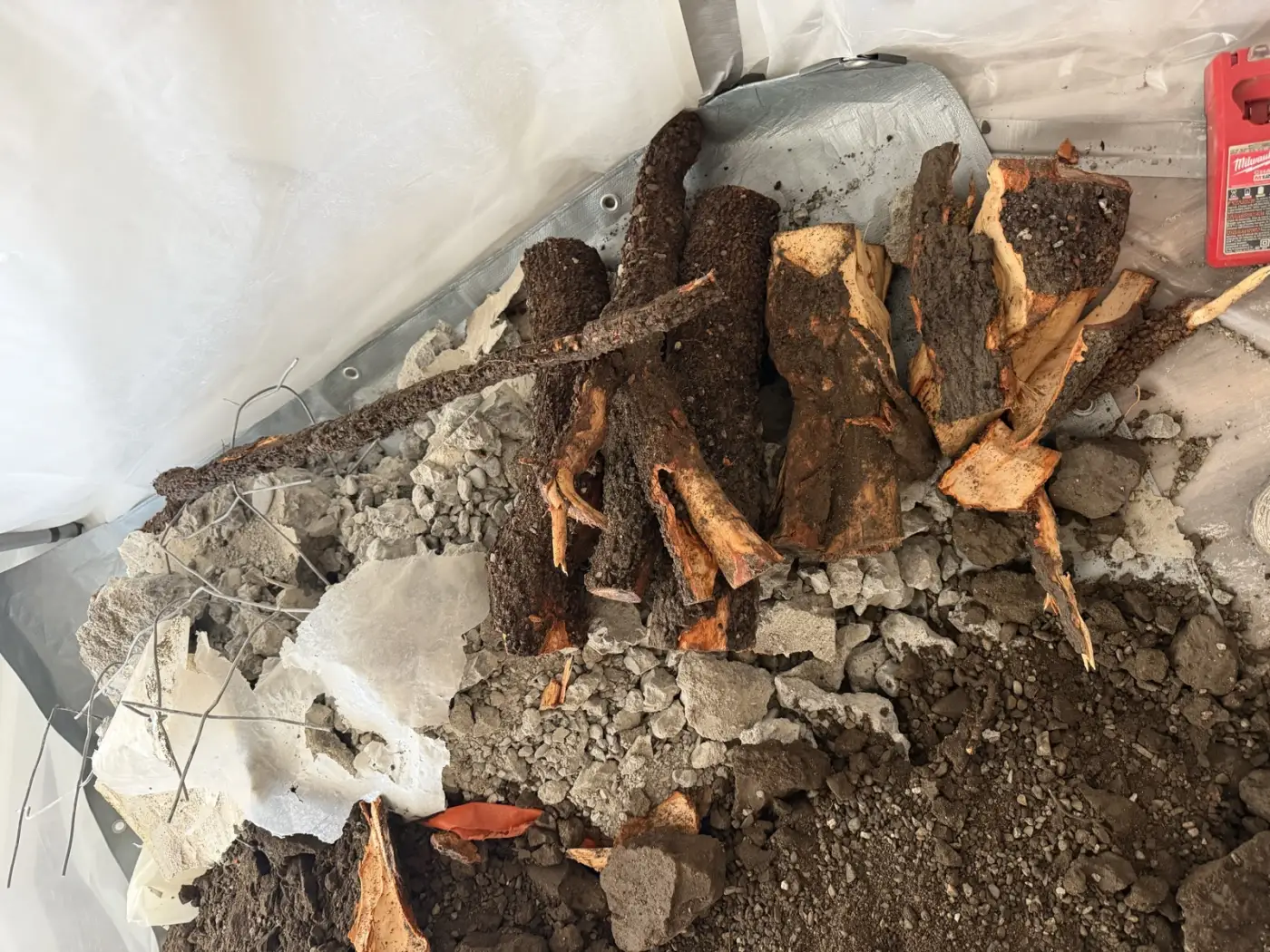
Tree roots seek out moisture and nutrients found in sewer lines. Roots enter through existing small cracks or joint gaps, then grow and expand inside the pipe, widening the damage. In the Bay Area, aggressive species like willow, eucalyptus, and Monterey pine are particularly problematic. Root intrusion is one of the most common issues our team encounters during sewer line repair.
Spring is when root activity peaks. Trees coming out of winter dormancy send roots aggressively toward any available moisture source — including the water seeping through a hairline crack in your PVC sewer line. A crack that was stable over winter can become a serious root intrusion problem by midsummer if not addressed now.
Age-Related Brittleness
While PVC has a theoretical service life of 50-100+ years, real-world conditions reduce this. Older PVC formulations (pre-1980s) were less flexible and more prone to brittleness. After decades of pressure cycling, temperature fluctuations, and soil stress, even well-installed PVC loses flexibility and becomes more susceptible to cracking.
Manufacturing Defects
During extrusion, the molten PVC must fuse completely as it forms the pipe wall. If fusion is incomplete, “knit lines” form, creating invisible weak zones that can split longitudinally under normal operating pressure, sometimes years after installation.
Cracked PVC Pipe Repair Methods Compared
The right repair method depends on crack type, pipe location (above-ground vs. underground), pipe diameter, and whether the pipe carries pressurized water or gravity-flow sewage.
| Repair Method | Best For | DIY Possible? | Durability | Bay Area Cost (2026) |
|---|---|---|---|---|
| PVC epoxy/sealant | Hairline cracks, small above-ground leaks | Yes | Temporary (6-24 months) | $15 - $40 (materials) |
| Rubber repair coupling | Small to moderate cracks, accessible pipes | Yes | Semi-permanent (3-10 years) | $20 - $60 (materials) |
| Fiberglass wrap | Small cracks on accessible above-ground pipe | Yes | Temporary (6-18 months) | $20 - $50 (materials) |
| Cut-and-replace with coupling | Localized damage, accessible above-ground pipe | Moderate DIY | Permanent | $30 - $80 (materials) |
| Professional section replacement | Underground cracks, moderate damage | No | Permanent | $500 - $2,500 |
| Trenchless pipe lining (CIPP) | Multiple cracks, aging underground lines | No | Permanent (50+ year lifespan) | $3,000 - $8,000 |
| Trenchless pipe bursting | Severely damaged or collapsed underground pipe | No | Permanent (50+ year lifespan) | $4,000 - $12,000 |
| Full excavation replacement | Collapsed pipe, severe root damage, bellied pipe | No | Permanent | $5,000 - $15,000+ |
DIY Repair Methods (Above-Ground, Accessible Pipes Only)
These methods are appropriate only for accessible, above-ground PVC pipes such as those under sinks, in crawl spaces, or in exposed utility runs. They should never be used as a permanent fix for underground pipes or pressurized main water lines.
A note for DIYers considering underground work: We understand the temptation to save money by fixing a cracked PVC pipe yourself, especially if you have successfully repaired above-ground plumbing before. But underground pipe repair is fundamentally different. Alameda County and the City of San Leandro require permits and licensed contractor work for underground plumbing. Improper backfill, inadequate slope, or incorrect fittings underground can cause failures that are far more expensive to fix than the original problem. If your cracked pipe is underground, the most cost-effective path is usually a professional repair done right the first time.
Epoxy Putty or PVC Sealant
When to use: Hairline cracks or pinhole leaks on low-pressure, accessible PVC pipe.
Materials needed: PVC-rated epoxy putty (such as Oatey Fix-It Stick or JB Weld PlasticWeld), sandpaper (120-grit), clean rags, acetone or PVC cleaner.
Steps:
- Shut off the water supply and drain the pipe completely.
- Sand the area around the crack lightly to create a rough bonding surface.
- Clean the area thoroughly with acetone or PVC cleaner. The surface must be completely dry.
- Knead the epoxy putty until uniformly colored and apply it over the crack, extending at least 1 inch beyond each end.
- Smooth the epoxy and allow it to cure per manufacturer instructions (typically 1-2 hours for handling, 24 hours for full cure).
- Restore water flow and check for leaks.
Limitations: This is a temporary fix. Epoxy patches on PVC typically last 6-24 months before the underlying crack progresses. Use this method to stop an active leak while you schedule a permanent repair.
Rubber Repair Coupling (Fernco or Band Coupling)
When to use: Moderate cracks or splits on accessible pipe where you need a more durable temporary fix without cutting the pipe.
Materials needed: Stainless steel band repair coupling sized to your pipe diameter, screwdriver or nut driver.
Steps:
- Shut off water and drain the pipe.
- Clean and dry the pipe surface around the damaged area.
- Position the rubber coupling over the crack, ensuring the rubber gasket fully covers the damage.
- Tighten the stainless steel bands evenly using a screwdriver. Do not overtighten, as this can crack PVC further.
- Restore water and check for leaks.
Limitations: Band couplings are not code-approved as a permanent repair in most jurisdictions, including Alameda County. They work well as an interim fix for 3-10 years on drain lines but should not be used on pressurized water supply lines.
Fiberglass Wrap Repair
When to use: Small cracks on accessible pipes where you want a quick, water-activated repair.
Materials needed: Fiberglass repair wrap kit (such as SylWrap or FiberFix), gloves, water.
Steps:
- Shut off water and drain the pipe.
- Sand the pipe surface lightly and clean it.
- Activate the fiberglass wrap with water per product instructions.
- Wrap the tape tightly around the damaged section, overlapping each layer by 50%.
- Apply 5-8 layers for a strong repair.
- Allow to cure (typically 15-30 minutes).
Limitations: Fiberglass wraps are a temporary patch that can loosen over time, particularly on underground pipes or pipes subject to vibration. Not suitable for joints or pressure applications above 50 psi.
Cut-and-Replace with Slip Couplings
When to use: This is the proper DIY repair for localized damage on accessible above-ground PVC pipe. It produces a permanent, code-compliant repair.
Materials needed: PVC pipe (same diameter and schedule as existing), two slip couplings, PVC primer, PVC solvent cement, pipe cutter or hacksaw, measuring tape, marker, sandpaper.
Steps:
- Shut off water and drain the pipe.
- Mark cut lines at least 2 inches beyond each end of the damaged area.
- Cut the pipe cleanly at both marks using a pipe cutter or fine-tooth hacksaw.
- Cut a replacement section of new PVC pipe to fit the gap (accounting for coupling depth on both ends).
- Deburr all cut ends with sandpaper.
- Dry-fit all components to verify alignment and fit.
- Apply PVC primer to all mating surfaces (pipe ends and coupling interiors).
- Apply PVC solvent cement and quickly assemble, giving each joint a quarter-turn for even cement distribution.
- Hold each joint for 30 seconds to prevent push-out.
- Allow full cure time before restoring pressure (typically 2 hours for non-pressure applications, 24 hours for pressurized lines).
This is the only DIY method that produces a permanent repair equivalent to the original pipe.
Professional Repair Methods (Underground and Complex Situations)
Underground PVC pipe repairs require professional equipment, expertise, and permitting. Bay Area building codes in San Leandro and Alameda County require licensed contractors for underground plumbing work.
Professional Section Replacement (Excavation)
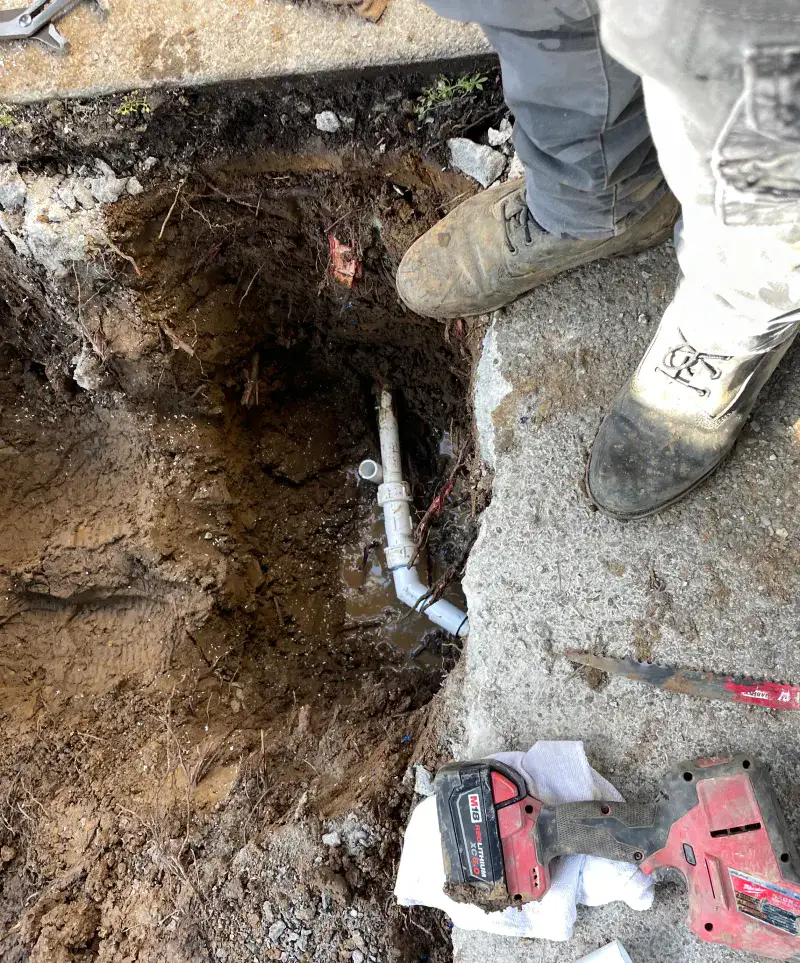
A plumber excavates down to the damaged section, cuts out the cracked portion, and installs a new PVC section with proper couplings and cement. This is the standard approach for a single, localized crack or break in an accessible underground pipe.
Bay Area cost (2026): $500-$2,500 depending on depth, location, and surface material (digging through a concrete driveway costs more than through lawn).
Trenchless Pipe Lining (CIPP)
Cured-in-place pipe lining inserts a resin-saturated flexible liner into the existing damaged pipe. The liner is inflated against the pipe walls and cured with hot water, steam, or UV light, creating a new smooth pipe within the old one.
Bay Area cost (2026): $3,000-$8,000 for a typical residential sewer lateral (30-60 feet). CIPP is ideal when multiple cracks, root intrusion, or general deterioration affect the entire line. Total UC provides trenchless sewer repair and replacement using this method.
Advantages: No excavation required, preserves landscaping and driveways, completed in one day, 50+ year expected lifespan for the new liner.
Trenchless Pipe Bursting
A bursting head is pulled through the existing damaged pipe, fracturing it outward while simultaneously pulling a new HDPE (high-density polyethylene) pipe into place. This effectively replaces the old pipe with a new one without trenching.
Bay Area cost (2026): $4,000-$12,000 for a residential sewer lateral, depending on length and access. Pipe bursting is the best option when the existing PVC pipe is too damaged for lining (collapsed, severely offset joints, or major root damage).
Full Excavation and Replacement
When trenchless methods are not feasible (severely bellied pipe, multiple directional changes, or inadequate access points), traditional excavation and full pipe replacement is necessary.
Bay Area cost (2026): $5,000-$15,000+ depending on length, depth, surface materials, and permit requirements. This is the most disruptive but sometimes the only viable option for severely compromised underground systems.
When to Repair vs. When to Replace
This decision depends on the pipe’s overall condition, age, and the economics of ongoing repairs versus one-time replacement.
| Factor | Lean Toward Repair | Lean Toward Replacement |
|---|---|---|
| Number of problem areas | Single crack or isolated issue | Multiple cracks, widespread deterioration |
| Pipe age | Less than 25 years old | Over 40 years old |
| Pipe condition (via camera) | Localized damage, pipe otherwise sound | General brittleness, root intrusion throughout |
| Repair history | First repair | Second or third repair in 5 years |
| Pipe material era | Modern PVC (Schedule 40, post-1990) | Early PVC formulations (pre-1980), Orangeburg, clay |
| Cost comparison | Repair cost is less than 40% of replacement | Repair cost approaches 50%+ of replacement |
Rule of thumb: If a professional camera inspection reveals that damage extends beyond a single localized area, or if the pipe has been repaired multiple times, full replacement using trenchless methods is typically the more economical long-term choice. Schedule a sewer line inspection to get a clear picture of your pipe’s overall condition before deciding.
Our stance: We have seen too many homeowners spend $1,500-$2,500 on a spot repair only to need another repair within two years, then eventually replace the whole line anyway — spending $8,000-$12,000 total instead of the $4,000-$8,000 a one-time trenchless replacement would have cost upfront. If your pipe is over 30 years old and a camera inspection shows deterioration beyond the immediate crack, replacement is almost always the better investment. A new CIPP lining or HDPE pipe gives you 50+ years of reliable service and eliminates the stress of wondering when the next failure will happen.
Underground vs. Above-Ground PVC Repair Considerations
The location of your cracked PVC pipe significantly affects the repair approach, cost, and urgency.
Above-Ground Pipes
Pipes under sinks, in crawl spaces, basements, or utility rooms are accessible and visible. Leaks are detected quickly, and many repairs can be completed as DIY projects using the cut-and-replace method described above. Costs are low (under $100 in materials), and repairs can be completed in under an hour.
Underground Pipes
Underground PVC repairs involve additional challenges:
- Excavation costs: Accessing the pipe requires digging, which adds $500-$3,000+ to the repair depending on depth and surface material.
- Permitting: Alameda County and the City of San Leandro require permits for underground plumbing work. A licensed contractor must pull the permit and schedule inspections.
- Soil conditions: Bay Area clay soils are difficult to excavate when wet and can collapse during open-trench work, requiring shoring or trench boxes for safety.
- Pipe location uncertainty: Unlike above-ground pipes you can see, underground pipes may not follow the expected route. Video camera inspection and electronic locating are often needed before excavation.
- Restoration costs: After excavation, you may need to restore landscaping, concrete, pavers, or asphalt, adding to the total project cost.
This is why trenchless repair methods have become the preferred approach for underground PVC pipe repair in the Bay Area. Total UC’s sewer and drain services include trenchless options that eliminate most of these challenges.
Bay Area Soil and Environmental Factors
Several regional factors specific to the San Francisco Bay Area accelerate PVC pipe deterioration and influence repair decisions.
Expansive Clay Soils
The clay-heavy soils across San Leandro, Castro Valley, Hayward, and Fremont exert significant lateral pressure on buried PVC pipes. During wet seasons, the soil swells and pushes inward on pipes. During dry seasons, the soil contracts and pulls away, removing support. This cycle fatigues PVC pipe walls and joints over decades.
Seismic Activity
The Hayward Fault runs through the East Bay, and ground movement from even minor seismic events can shift pipe alignment, separate joints, and crack rigid PVC sections. After any earthquake, it is wise to run a water meter test and monitor your system for signs of new damage.
Root-Aggressive Vegetation
Bay Area properties often feature mature trees with extensive root systems. Willows, redwoods, eucalyptus, and even ornamental trees like magnolias send roots deep enough to reach sewer laterals. Roots enter through joints and hairline cracks, then expand to cause major damage.
Temperature Stability
One advantage of the Bay Area climate is that ground temperatures remain relatively stable year-round (55-65 degrees F at typical pipe depth). Unlike regions with freeze-thaw cycles, Bay Area PVC pipes are not subject to ice expansion damage, which is a significant plus for pipe longevity.
Which Situation Sounds Like Yours?
See which scenario matches what you are dealing with, and what the right next step is.
”I found a crack in a PVC pipe under my sink or in my crawl space.”
This is the simplest scenario. The pipe is accessible, you can see the damage, and a permanent cut-and-replace repair with slip couplings is well within DIY ability. Pick up the materials at any hardware store for under $50, follow the steps above, and you will have a permanent fix in about an hour. The only reason to call a pro for this is if the pipe connects to a main stack or if you are uncomfortable working with PVC cement.
”My drains are slow throughout the house and a plumber said I have a cracked sewer line.”
This is an underground problem that requires professional attention. The critical question is: how extensive is the damage? Before committing to any repair, insist on a video camera inspection. A single localized crack may be a $500-$2,500 spot repair, but if the camera reveals multiple cracks, root intrusion at several joints, or general pipe deterioration, trenchless replacement is the better long-term investment. Ask your contractor to show you the camera footage and explain exactly what they see.
”I am selling my home and the buyer’s inspection found PVC pipe damage.”
This is increasingly common in Bay Area real estate transactions, especially where a sewer lateral certificate is required at sale, as in Oakland, Berkeley, Alameda and Piedmont. There is no single deadline for homeowners: in the EBMUD area the certificate is due when the property sells, when remodeling tops $100,000 or when the water meter size changes. Get a professional assessment and repair estimate early in the transaction so a failed test does not hold up escrow.
”I tried an epoxy patch six months ago and it is leaking again.”
A failed temporary repair is your signal that the underlying problem is bigger than a surface patch can handle. The crack has likely propagated, or the pipe has deteriorated to the point where adhesive repairs cannot hold. The next step is a professional assessment — either a section replacement if the damage is localized, or trenchless relining if the pipe condition is marginal throughout. Do not spend more money on temporary fixes.
Your Next Steps
Here is exactly what to do depending on your situation:
-
For above-ground cracks you can see and access: Buy PVC pipe, slip couplings, primer, and cement. Follow the cut-and-replace method in this guide. Total cost: under $50. Time: about an hour.
-
For suspected underground PVC damage: Schedule a video camera inspection to see exactly what you are dealing with. Total UC offers same-week availability for most Bay Area locations. The inspection gives you the information you need to make a smart repair-or-replace decision.
-
For properties heading into a sale: Check whether your area requires a sewer lateral certificate at sale (the EBMUD area, Berkeley, Castro Valley and the Oro Loma district do) and book the inspection at the start of escrow so any repair fits the timeline.
-
For recurring problems after previous repairs: Stop patching and get a comprehensive camera assessment. You may be spending more on repeated fixes than a one-time replacement would cost.
The months after the rainy season are the best time for underground PVC work in the Bay Area. The ground is moist enough for clean excavation, trenchless equipment performs at its best in those soil conditions, and you get ahead of the summer soil contraction that causes new failures. Schedule your inspection or repair early, before contractor calendars fill.
Prevention: How to Protect Your PVC Pipes
-
Schedule regular camera inspections. A video inspection every 2-3 years catches cracks, root intrusion, and joint problems before they become emergencies. For older homes (pre-1990 construction), annual inspections are recommended.
-
Manage tree roots. Maintain a minimum 10-foot buffer between trees and known sewer line routes. Apply root-inhibiting treatments (copper sulfate or foaming root killer) annually if you have mature trees near underground pipes.
-
Avoid chemical drain cleaners. Harsh chemical drain cleaners can weaken PVC joints and gaskets over time. Use enzymatic drain maintenance products instead, or schedule professional drain cleaning.
-
Protect exposed PVC from sunlight. Any PVC pipe exposed to direct sunlight should be painted with latex paint or wrapped with UV-protective tape to prevent UV degradation.
-
Know what is above your pipes. Avoid parking vehicles, placing heavy equipment, or building structures directly above shallow underground PVC lines. If you are planning construction or landscaping, have your underground utilities located first (call 811).
-
Install cleanout access points. If your system lacks cleanout access, having one installed ($300-$600) makes future inspections and maintenance far easier and less expensive.
-
Monitor water usage. Unexplained increases in water bills often indicate a leak in a pressurized PVC water line. Catching it early means a simple repair instead of a major replacement. Total UC provides water line repair, installation, and repiping for water supply systems.
What to Expect: Immediate and Long-Term Outcomes
When You Fix the Problem Now
Immediately: The leak stops, water bills return to normal, drain flow is restored, and the risk of further property damage ends. For above-ground repairs, this happens the same day. For underground repairs, most trenchless methods are completed in one day with minimal property disruption.
Long-term: A proper repair or replacement eliminates the source of soil erosion, prevents foundation damage, stops root intrusion from worsening, and gives you years (or decades) of reliable service. Trenchless relining provides 50+ years of lifespan. Pipe bursting with new HDPE gives you 50-100 years. Either way, you are done worrying about that pipe.
When You Wait
Short-term: The crack widens, water loss increases, roots grow further into the pipe, and soil erosion accelerates. What was a $500-$2,500 repair becomes a $5,000-$15,000 replacement.
Long-term: Foundation damage, recurring backups, mold issues, and potential code violations if you are in a sewer lateral compliance area. The East Bay sits on the Hayward Fault, and the next seismic event could turn a weakened pipe into a full failure overnight.
Frequently Asked Questions
Can you repair a cracked PVC pipe without replacing it?
Yes, but the appropriate method depends on the crack type and pipe location. Above-ground hairline cracks can be temporarily patched with epoxy putty or rubber couplings, while a cut-and-replace with slip couplings provides a permanent fix. For underground PVC pipes, trenchless pipe lining (CIPP) effectively repairs cracks from the inside without excavation by creating a new pipe within the old one. However, severely crushed, collapsed, or heavily root-damaged pipes typically require section replacement or pipe bursting rather than patching.
How much does it cost to repair a cracked PVC pipe in the Bay Area?
Costs vary significantly by location and severity. A simple above-ground repair with PVC couplings costs $30-$80 in materials for a DIY fix. Professional underground spot repairs run $500-$2,500 in the San Leandro area in 2026. Trenchless lining of a full sewer lateral (30-60 feet) costs $3,000-$8,000, while pipe bursting for a complete replacement runs $4,000-$12,000. Traditional excavation replacement ranges from $5,000-$15,000+ depending on depth, length, and surface restoration needs.
Is it better to repair or replace a cracked PVC sewer line?
If a camera inspection reveals only one or two isolated cracks in an otherwise sound pipe that is less than 30 years old, repair is usually the economical choice. However, if the pipe shows widespread deterioration, multiple cracks, significant root intrusion, or has been repaired previously, full replacement (preferably trenchless) is the better long-term investment. Replacing an aging line with modern HDPE via pipe bursting gives you 50-100 years of service life and eliminates the cycle of recurring repairs.
How long does a PVC pipe repair last?
Temporary fixes like epoxy putty and fiberglass wraps typically last 6-24 months. Rubber repair couplings can last 3-10 years on drain lines. A proper cut-and-replace repair with solvent-welded couplings is permanent and will last as long as the original pipe. Professional trenchless lining (CIPP) has an expected service life of 50+ years, and pipe bursting with new HDPE pipe provides 50-100 years of reliable service.
Can tree roots crack PVC pipes?
Absolutely. Tree roots are one of the most common causes of PVC pipe damage in the Bay Area. Roots are attracted to the moisture and nutrients inside sewer lines. They enter through joints, gaskets, and existing hairline cracks, then grow and expand inside the pipe, cracking it from within. Species like willows, eucalyptus, and mature oaks are especially aggressive. Regular camera inspections and root maintenance treatments are the best defense. If root damage is already present, Total UC can assess whether lining, bursting, or section replacement is the best approach through our sewer and drain services.
Is spring the best time to repair underground PVC pipes?
Spring into early summer, after the rains end, is usually the best window for underground pipe work in the Bay Area. The ground is moist enough for clean excavation but firm enough for stable trench walls. Trenchless equipment (lining and bursting) performs best in these soil moisture conditions. And scheduling is easier in spring than in late summer, when drought-related soil contraction causes a surge in new pipe failures and demand for repair services spikes.
Trust Total UC for Professional PVC Pipe Repair
Total Underground Construction serves San Leandro and the entire Bay Area with expert underground pipe repair services. From video camera inspections that diagnose the problem to trenchless sewer repair and water line repair and repiping, our team handles every aspect of cracked PVC pipe repair with minimal disruption to your property.
With spring ground conditions at their best and contractor schedules still open before the summer rush, now is the ideal time to get your PVC pipe issue resolved. Whether you need a quick diagnosis, a repair estimate, or a full replacement plan, we are ready to help.
Call Total UC today at (415) 350-3363 or request a free estimate for a professional assessment of your cracked PVC pipe.
Written by Joseph Dometita, Total Underground Construction. Our team brings decades of hands-on experience with Bay Area underground utility systems, ensuring every repair is done right the first time.